



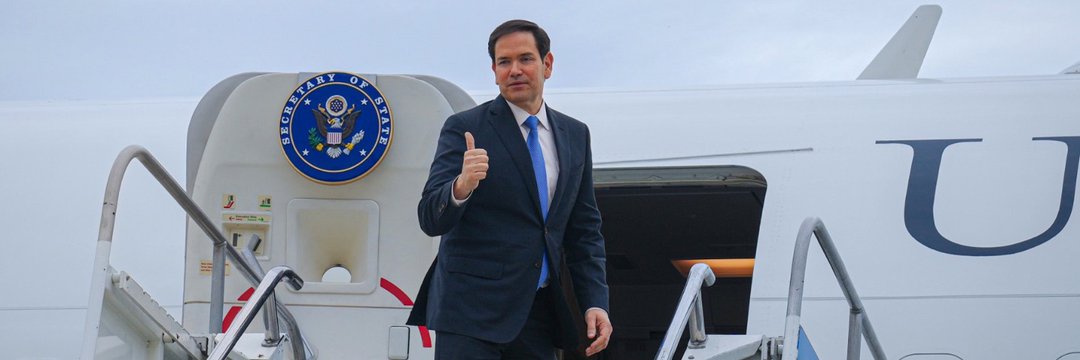
The United States has reaffirmed its hardline stance on Taiwan, warning that any attempt by China to forcibly alter the status quo in the Taiwan Strait would destabilise global peace and damage relations between Washington and Beijing.
Speaking before high-level talks between U.S. President Donald Trump and Chinese President Xi Jinping in Beijing this week, U.S. Secretary of State Marco Rubio said Washington’s position on Taiwan remained unchanged despite growing tensions between Beijing and Taipei.
“The U.S. policy on the issue of Taiwan is unchanged as of today,” Rubio said in remarks released before the bilateral engagements. “China always raises it on their side and we always make clear our position and move on to other topics. From our perspective, any forced change in the status quo and the situation that’s there would be bad for both countries.”
Rubio’s remarks came as Chinese President Xi Jinping reportedly raised the Taiwan issue directly with President Donald Trump during discussions aimed at easing tensions between the world’s two largest economies.

The Taiwan issue remains one of the most sensitive flashpoints in U.S.-China relations. China considers Taiwan a breakaway province that must eventually be reunified with the mainland, by force if necessary. Taiwan, however, operates as a self-governing democratic territory with its own constitution, military and elected leadership.
Although the United States officially recognises Beijing under the “One China” policy, Washington remains Taiwan’s most important international supporter and arms supplier. U.S. officials have repeatedly warned against any military action targeting the island.


Rubio further stressed that peace and stability in the Taiwan Strait were critical not only for the region but also for the global economy, particularly because Taiwan plays a central role in semiconductor manufacturing and international trade.
His comments come amid increasing Chinese military activity around Taiwan. Taiwan’s defence authorities recently reported the presence of Chinese warships and military aircraft operating near the island, developments Taipei has described as intimidation tactics designed to pressure its government.
International analysts say the latest remarks from Rubio signal that Washington is unlikely to soften its support for Taiwan despite ongoing diplomatic engagements with Beijing.
The developments also carry significant implications for Eswatini, Africa’s only remaining formal diplomatic ally of Taiwan.
Since establishing diplomatic relations with Taiwan in 1968, Eswatini has consistently resisted pressure from Beijing to sever ties with Taipei in favour of China. Most African nations switched recognition to Beijing decades ago, leaving the Kingdom isolated on the continent in maintaining official relations with Taiwan.
Over the years, Taiwan has provided Eswatini with extensive development assistance in sectors such as health, education, agriculture and infrastructure. Taiwanese-funded projects in the Kingdom include hospital support programmes, agricultural training initiatives and scholarship opportunities for emaSwati students.
Political observers say Eswatini’s continued support for Taiwan has given the Kingdom strategic importance in international diplomacy, particularly as competition between China and the United States intensifies.
In recent years, China has reportedly increased diplomatic pressure on Eswatini to abandon Taiwan, including imposing restrictions on visas for emaSwati citizens travelling to China and also using tarrifs. However, the government under His Majesty King Mswati III has repeatedly reaffirmed its commitment to relations with Taiwan.
Just recently Taiwanese President Lai Ching-te visited Eswatini and praised the Kingdom for maintaining what he described as a steadfast friendship with Taiwan despite mounting international pressure.
During the visit, the two governments pledged to strengthen cooperation in agriculture, technology, healthcare and economic development.


Discussion about this post