



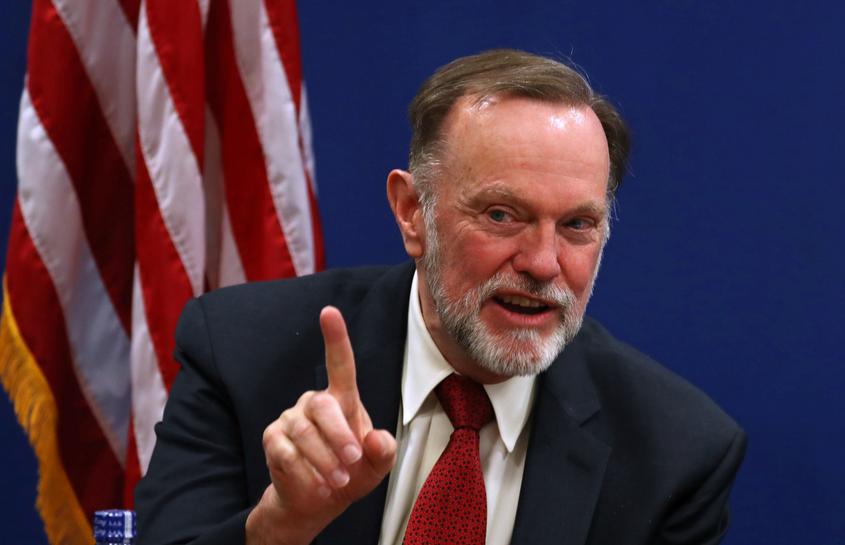
Former United States Assistant Secretary of State for African Affairs Tibor Nagy has accused China of hypocrisy following Beijing’s sharp criticism of Eswatini over the recent visit by Taiwanese leader Lai Ching-te.
Nagy, a former US ambassador to both Guinea and Ethiopia and now Professor Emeritus at Texas Tech University, weighed in after China issued a strongly worded statement condemning Eswatini for hosting Lai during his recent African trip.
“The hypocrisy here is overwhelming,” Nagy said in reaction to the Chinese statement. “China criticizing Eswatini for being ‘kept and fed’ by Taiwan.
How many times more African elites, politicians, and media personalities does China ‘keep and feed’? Does China believe people are too ignorant to know?”.


His comments came after Chinese Foreign Ministry spokesperson Lin Jian launched an extraordinary verbal attack on both Taiwan and unnamed Eswatini politicians over the visit.
During a press briefing carried by Chinese state media, Lin accused Lai of sneaking into Eswatini aboard King Mswati III’s private aircraft and described the trip as a “scandalous publicity stunt.”
China also claimed that countries adhering to the One China principle had denied Lai access to their airspace during his return flight to Taiwan.“Some politicians in Eswatini, in the pay of Taiwan, have wrongly provided space for ‘Taiwan independence,’” Lin said.
“The politicians of these countries must make a wise decision and stop going further down this dead-end path.”
China further reiterated its longstanding position that there is only one China and that Taiwan forms part of Chinese territory.
Eswatini remains the only African country that maintains formal diplomatic relations with Taiwan instead of Beijing, making the kingdom a critical ally for Taipei on the continent.
The relationship between Eswatini and Taiwan has repeatedly drawn criticism from China, which has aggressively sought to isolate Taiwan diplomatically around the world.
Lai’s visit to Eswatini was viewed as strategically important for Taiwan as it seeks to preserve its number of diplomatic allies amid growing pressure from Beijing.
China considers Taiwan a breakaway province and has vowed eventual reunification, by force if necessary. However, Nagy’s remarks have now injected a broader geopolitical debate into the issue, particularly concerning China’s influence across Africa.
Observers say China has, over the years, expanded its footprint on the continent through infrastructure financing, trade partnerships, scholarships, media exchanges, and political cooperation programmes.
Critics in Western countries have often argued that Beijing uses economic leverage to secure diplomatic loyalty from African governments.
China has consistently rejected such accusations, insisting that its engagement with Africa is based on mutual respect, development cooperation, and non-interference in domestic affairs.
The latest diplomatic row highlights intensifying competition between China and Taiwan for influence in Africa, even though Taiwan’s formal diplomatic presence on the continent has shrunk significantly over the past two decades.
Several African countries that once recognised Taiwan have switched allegiance to Beijing, attracted by China’s economic power and investment promises.Eswatini, however, has maintained close ties with Taiwan despite repeated diplomatic pressure from China.
Taiwan has supported various projects in the kingdom over the years, including in the health, education, agriculture, and infrastructure sectors.


Chinese officials suggested during the briefing that there were growing calls within Taiwan’s remaining allies to establish ties with Beijing instead.“In recent years, we have heard voices from all walks of life in the so-called diplomatic allies of Taiwan calling for the development of relations with China,” Lin said.He argued that countries aligned with Taiwan risked becoming political props for Taiwanese separatist ambitions.
The Chinese spokesperson also defended decisions by some countries to deny Lai flight clearance through their airspace, saying such actions were consistent with international law and support for the One China policy.“The countries concerned, which adhere to the one-China principle, refused to issue flight clearances to Lai Ching-te,” Lin said. “This unequivocally proves that the one-China principle represents the general trend.”
China did not publicly identify which countries had allegedly denied overflight access, though questions during the briefing referenced nations including Madagascar, Mauritius, Indonesia, Malaysia, Philippines, Brunei and Australia.The comments have sparked discussion on social media and among diplomatic observers, with some viewing China’s language as unusually harsh toward a sovereign African state.
Others noted that Beijing’s criticism of Eswatini comes amid heightened tensions across the Taiwan Strait and increasing international attention on China’s efforts to diplomatically isolate Taiwan. Eswatini has maintained that it will not be bullied on its sovereignty.


Discussion about this post