



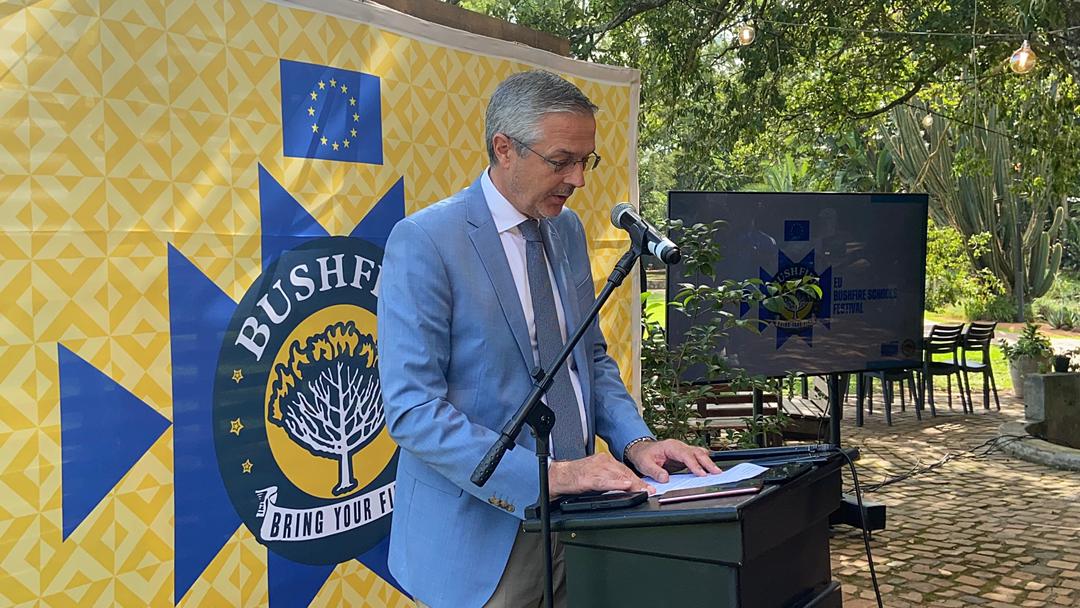
MALKERNS – The European Union (EU) has reaffirmed its long-standing commitment to youth empowerment and the creative industries through the launch of the 2026 EU Bushfire Schools Festival at House on Fire.
Delivering remarks at the official launch, EU Ambassador to Eswatini, H.E. Mr Karsten Mecklenburg, highlighted the significance of the festival as more than just a cultural event, but a platform for skills development, inclusion and economic opportunity for emaSwati youth.
Since establishing its presence in Eswatini in 1976, the EU has worked closely with Government, development partners and civil society to contribute to the country’s socio-economic development while tirelessly promoting local arts. The EU Bushfire Schools Festival, a rewarding partnership with House on Fire, stands as one of the key outcomes of this collaboration, revealing new possibilities for careers in the creative industries.
For over a decade, the EU has supported the Schools Festival, which takes place ahead of the main MTN Bushfire Festival. The initiative brings together more than 600 high school learners annually for a day of workshops, artistic expression and skills-based learning alongside professional artists and industry stakeholders. Over the years, nearly 10,000 young people have benefited from the programme.


Explaining why the EU continues to invest in the creative sector, Ambassador Mecklenburg said the EU believes strongly in multilateralism and cooperation for development. In Eswatini, the EU remains the largest supporter of civil society initiatives, including those in the cultural space.
“Art unites us. It speaks to our shared humanity in a universal language accessible to all,” he said.
He emphasised that the EU Delegation has been on a mission to promote the creative industries as drivers of economic growth, development and job creation. The current EU cooperation programme in Eswatini places strong focus on youth, recognising young people as drivers of social and technological innovation and sources of new ideas and unbridled creativity.


“We wish to empower the youth of Eswatini with skills for quality jobs, entrepreneurship and social inclusion, skills for the 21st century, skills that the creative industries provide and develop,” he said.
The 2026 festival is being held under the theme “Art in Action. Future in the Making,” coinciding with the EU’s celebration of 50 years of partnership with the Kingdom of Eswatini.
Expanding Access for Rural Girls
The impact of the Schools Festival extends beyond the stage. Lindiwe Dladla, representing Days for Today, shared how exposure to such platforms transforms the lives of rural learners, particularly girls.
Through a Rotary Global Grant-funded project implemented since 2024, Days for Today works with schools in the Lubombo region, including Maphungwane and Tikhuba. The organisation has established 22 school clubs across 11 schools, reaching more than 600 learners, half of whom are boys, focusing on life skills, confidence-building and peer support.
“For many girls in rural Eswatini, the challenge is no longer just access to education, but access to possibility,” Dladla said.
In 2025, 15 learners from Maphungwane attended the EU Bushfire Schools Festival for the first time. The experience proved transformative. Learners engaged in visual art addressing period poverty and performed a skit tackling menstrual equity, topics often left unspoken in their communities.
One learner reflected: “Before the festival, I had never travelled outside my community. I was shy and afraid to speak in front of others. But when we performed our skit, I felt proud.”
Upon returning home, the learners initiated projects inspired by the festival, including plans to build a “friendship bench” using recycled materials to promote peer support at school.
Importantly, boys are also part of the transformation. Through boys’ clubs, young men are becoming more empathetic and supportive of gender equality issues. One participant shared that the experience helped him better understand the challenges girls face and encouraged him to speak openly about them.
Creativity as a Development Tool
Also speaking at the launch, Melaine from Likusasa Letfu underscored that creativity is not a luxury, but an essential 21st-century skill.
“Creativity is a way of thinking, a way of solving problems and imagining futures that do not yet exist,” she said.
Now in its second year partnering with the festival, Likusasa Letfu is focusing on futures thinking, encouraging young people to ask what kind of future they want and how they can turn their talents into meaningful contributions for their communities.
In partnership with the Eswatini Theatre Club, the organisation is also exploring new cultural narratives shaped by young voices.
“The future is not something that will simply happen to us. It is something we actively shape, through ideas, courage and creativity,” she said.
Shaping Futures Through Art
The EU Bushfire Schools Festival continues to demonstrate that investing in arts and creativity is an investment in confident, capable and adaptable young people.
As Ambassador Mecklenburg concluded, performance arts and cultural industries play a crucial role in human development, social cohesion and inclusion, both in Europe and in Eswatini.
Through sustained partnership and shared vision, the festival is proving that when creativity is supported, futures are not only imagined, they are built.


Discussion about this post