



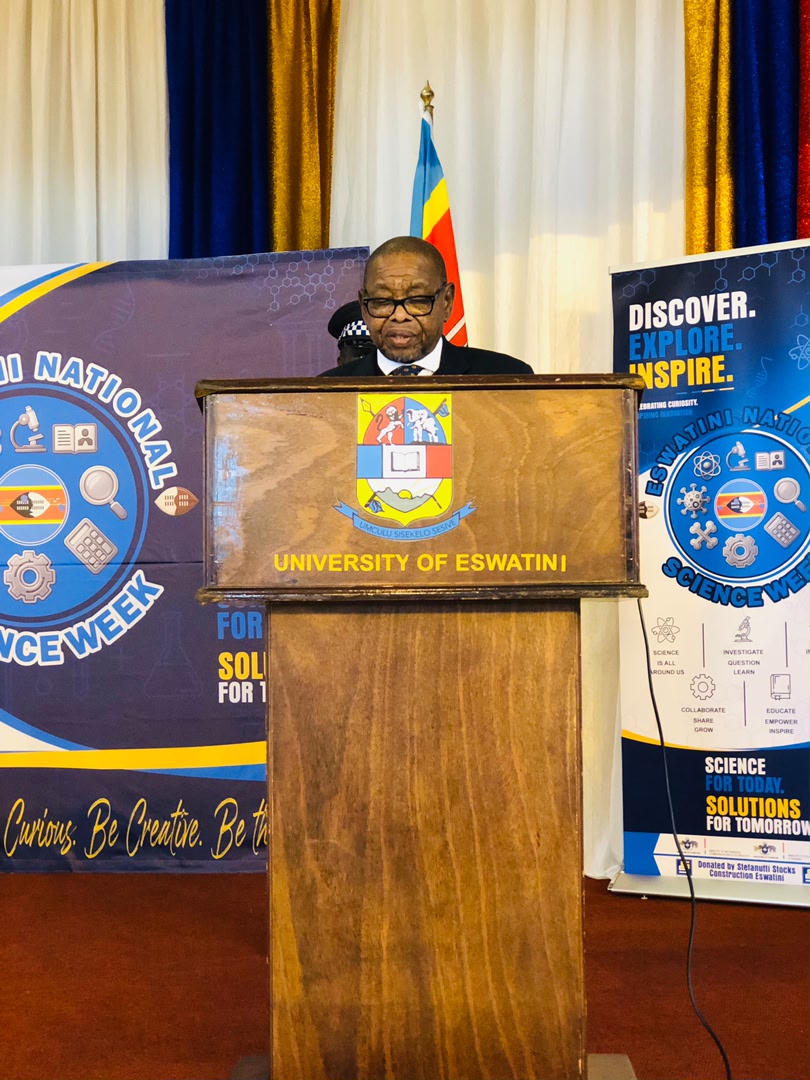
Matsapha- The Republic of South Africa’s Minister of Science, Technology and Innovation Professor
Blade Nzimande has urged African leaders to develop the capacity to create its own technologies and
drive its own innovation agenda if it is to fully benefit from the opportunities presented by the rapidly
expanding digital economy.
Addressing delegates at the launch of Eswatini National Science Month 2026 at the University of
Eswatini on Monday, Nzimande said countries in the Southern African Development Community (SADC)
should move beyond being consumers of global technologies and instead invest in the research,
development and institutional capabilities needed to produce solutions tailored to the continent’s
needs.
The Minister said science, technology and innovation cooperation among African countries had become
increasingly important as the region confronts challenges ranging from health crises and climate change
to energy security, infrastructure development and economic transformation.
“As governments in the SADC region, we need to continually find ways of giving practical expression to
the SADC Protocol on Science, Technology and Innovation and, of course, the African Union’s Science,
Technology and Innovation Strategy for Africa,” he said.

This he said means that countries must consistently work at strengthening science, technology and
innovation cooperation.
According to Nzimande, meaningful cooperation should go beyond policy commitments and focus on
jointly developing evidence-based solutions to some of the region’s most pressing challenges.
To achieve this, he said governments must deliberately invest in the foundational capabilities required
for participation in the digital economy.
“These include strong legislative and institutional frameworks, as well as research and development
capacity that enables the continent to produce its own technological products and solutions,” he said.


The Minister cautioned that Africa’s digital transformation agenda should be driven by what he
described as a sovereign research and development agenda.
“By this, we mean a research and development agenda that is designed, funded and driven by African
countries themselves,” he said.
Nzimande stressed that such an approach should not be interpreted as opposition to international
cooperation.
“This is not a rejection of international partnerships with other regions of the world. Rather, it is an
affirmation of the importance of equity, mutual respect and African agency in our engagement with
global partners,” he said.
However, Nzimande noted that the benefits of the digital revolution have not been shared equally
across societies and countries.
“The rise of the digital age has not automatically produced greater economic equity. In some cases, it
has deepened historical inequalities, giving rise to what is often described as the digital divide, or even
digital apartheid,” he said.




Discussion about this post